The Awakened Journey
Blog
Kneeling at the Altar in Isaan
A chain of hands, a sudden surge, and my husband who felt nothing
10 July 2026
I didn't speak much Thai. I still don't. So when we landed in Isaan in 2008 — my first time in Thailand, my first time meeting my mother's side of the family — I mostly picked things up from watching. And what I watched, for the entire day, was a lot of cooking.
Pots everywhere. Sticky rice steaming. Neighbors dropping by to help chop something or stir something. One memory from that day has stayed just as vivid as the ceremony itself: watching someone make coconut milk entirely by hand, grating the coconut against something that looked like an old-fashioned washboard, then squeezing the milk out through what looked like cheesecloth. I'd never seen anything like it, and I still think about it. I remember thinking, almost offhand, we're feeding a lot of people today. I had no idea it was all leading up to something with my name on it.
My dad had been stationed in Isaan during the Vietnam War, which is how my parents met. This trip was the first time I'd ever set foot in that part of my own history — the village, the family, the language I only half understood. My husband and I had set our sights on getting there before my 30th birthday. We landed three days before it.
Kneeling at the altar
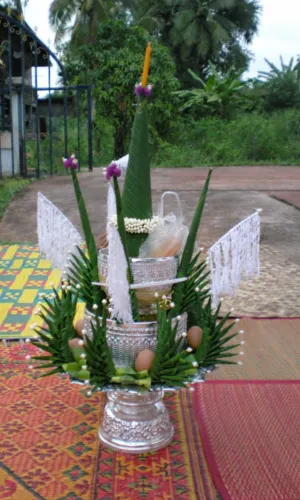
The altar itself didn't appear until that evening, right before the ceremony began — set up on the patio at the side of the house. It was a silver pedestal tray built up with tiers of banana leaf folded into pointed cones, white cloth triangles tucked between them, strings of small white flowers, and hard-boiled eggs nestled into the leaves. My husband and I knelt in front of it. Behind us, everyone else knelt too: family, neighbors, people from the village I'd never met and would likely never see again. It felt like the whole community had shown up.
One by one, most of the people there tied white cotton string around our wrists and pressed money into our hands. We ate sticky rice and hard-boiled egg. We were wrapped in fabric sashes across our bodies. I found out much later that this kind of ceremony — the string-tying, the rice, the egg — is common across Laos and Isaan, often called a baci or sou khwan, a calling back of the spirit. At the time, I didn't know any of that. I just knew I was being welcomed into something, and that it mattered.
The surge
Then the chain formed. Everyone kneeling behind us reached forward, hand to shoulder, person to person, until we were all connected in one unbroken line.
And that's when it hit me.
A sudden surge — a rush, swooshing through my body. Electric. Intense. A buzzing that started at my head and moved downward, strongest in my head and my torso. It wasn't subtle. It wasn't something I had to convince myself I'd felt.
I turned to my husband, kneeling right beside me, and asked, "Did you feel that?"
He gave me a puzzled look. He had no idea what I was talking about.
What I made of it
The sensation only lasted a few seconds. But it was strong enough that I remember it with total clarity almost two decades later — the buzzing, the direction it moved through me, the exact moment my husband's puzzled expression told me he hadn't shared it.
We kept celebrating late into the night. I didn't make a scene about it. I've told maybe a handful of close friends over the years, and that's it — it took a long time before I was ready to talk about any of this more openly . It's not a story I lead with.
This wasn't my first brush with something outside the ordinary — I'd had a few experiences back in college that opened a door I didn't fully understand at the time either. But Isaan was different. It wasn't private or internal. It happened in a circle of people, most of whom I couldn't even speak to, and my husband, right beside me, didn't seem to notice a thing.
Looking back now, I think of that human chain as a closed circuit — everyone in it a conductor, energy moving through the whole group. Whether everyone else could sense it too, I'll never know. I know my husband, holding my hand at the very center of it, didn't. And that's stayed with me as much as the sensation itself: that something can move through a room, real enough to leave a mark on one person's nervous system, and be completely invisible to the person right next to them.
I wouldn't have called any of this "energy work" back then. I wouldn't have called it anything. It would be another thirteen years before an aortic dissection and open-heart surgery gave me a language for it — before what happened on that patio in Isaan stopped being a strange memory and became one more entry in a much longer pattern.
If any of this resonates — if you've had a moment like this that you've never quite known what to do with — you're not alone in it, and you don't have to sit with it by yourself. That's a lot of what The Awakened Journey Collective is for: a space to talk about these experiences with people who won't ask you to explain them away.
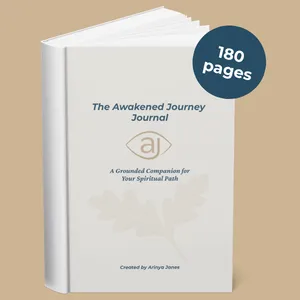
If you're looking for a more guided way to sit with your own story, the Awakened Journey Journal pairs memoir, science, and reflective prompts to help you trace your own thread back through your life.
And if this stirred something up for you, I'd love to hear about it — the contact form below is always open.


Explore your journey with the Awakened Journey Journal, Self-reflection Cards, or join us in the Awakened Journey Collective.